Table of Contents
- Vertical Kitchen Storage Solutions That Use Every Inch
- How to Organize a Small Kitchen Without a Pantry
- Custom Kitchen Cabinet Organization for Awkward Layouts
- Renter-Friendly Storage Solutions for Small Kitchens
- Budget vs. Premium Storage Solutions: What Actually Lasts
- Ergonomic Kitchen Workflow in Tight Spaces
- Maintenance Habits That Keep Small Kitchens Organized
- Frequently Asked Questions
Last Updated: September 11, 2026
Vertical Kitchen Storage Solutions That Use Every Inch
The single biggest mistake in a small kitchen is treating wall space as decoration. In practice, the walls are your real estate. A magnetic knife strip clears an entire drawer. A hanging rail above the prep counter frees the cabinet below it.
Vertical storage works because it converts unused height into accessible capacity. Here is what actually delivers:
- Wall-mounted racks for pots, pans, and utensils
- Magnetic knife strips on the backsplash
- Tension rods inside cabinets for cutting boards and trays
- Tiered shelving on the countertop to stack vertically, not outward
- Adhesive hooks for lightweight tools near the prep area
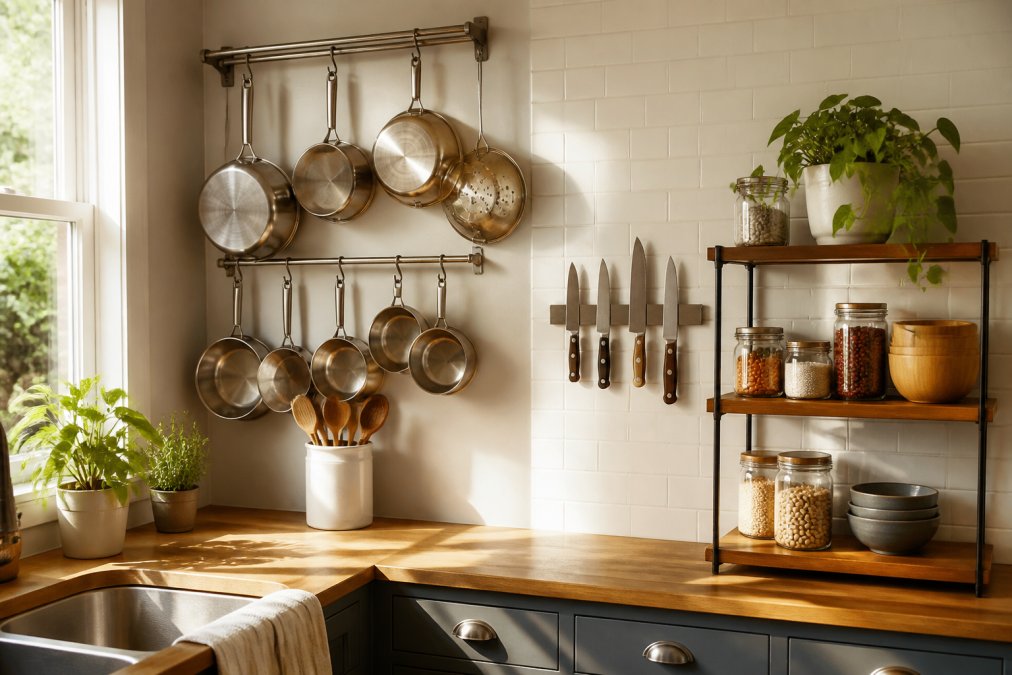
Measure your backsplash height before buying any rail. Most standard rails sit 45-60 cm above the counter, which keeps them clear of tall stockpots but still within arm’s reach.
How to Organize a Small Kitchen Without a Pantry
Organizing a small kitchen without a pantry comes down to one principle: group by frequency of use, not by category. Items you reach for daily belong at eye level and within arm’s reach. Everything else moves up or down. The mistake most people make is organizing by type, all the baking goods together, all the cans together, which buries the items you actually touch every day behind the ones you touch twice a year.
Before you buy a single container, measure your available zones. A standard upper cabinet shelf is about 10 to 12 inches deep and 11 to 12 inches tall, which is why a 10-inch riser fits almost anywhere and a 12-inch one often does not clear the shelf above it (hud.gov). Write down the height, width, and depth of every cabinet, drawer, and open shelf you can spare. That list is your shopping filter.
A common pattern is to convert a nearby closet, a deep drawer, or an open shelf into a pantry zone. A rolling utility cart is the most flexible option because it moves to wherever you are prepping and rolls out of the way when you are done, a 3-tier cart typically fits in a 12- to 14-inch gap between the fridge and the wall. If you have a coat closet within a few steps of the kitchen, a set of freestanding shelf risers turns it into a full pantry for the cost of a few risers.
For dry goods, decant into consistent containers so they stack. Square and rectangular containers waste far less shelf space than round ones, round containers leave dead corners on every shelf. For cans, use a tiered riser so you can see the back row; a 3-tier can riser roughly triples the visible capacity of a single shelf. Label the lids, not the fronts, so you can read them from above when the shelf is full.
Storing flour, sugar, and grains in their original bags invites pests and spills (the EPA). Decant into sealed containers. Open bags in a small kitchen are the fastest route to a moth problem.
If you rent, keep the whole system non-permanent. Adhesive shelf risers, tension rods, and freestanding carts all come out clean. A tension rod wedged inside a cabinet turns a single shelf into two, and an over-the-door rack on a closet door adds a full spice wall without a single screw. None of it scars the cabinet, and all of it moves with you.
The real test of a pantry-less setup is whether you can find an item without moving three others. If you cannot, the problem is not lack of space, it is that your most-used items are not at eye level.
Custom Kitchen Cabinet Organization for Awkward Layouts
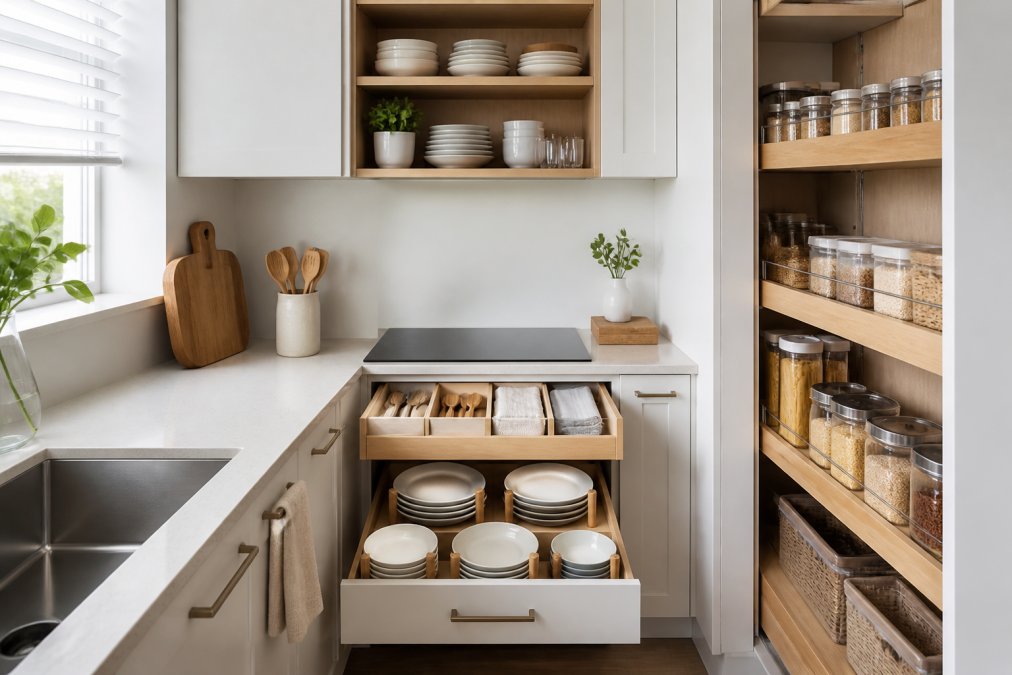
Custom kitchen cabinet organization solves what off-the-shelf inserts cannot: corners that swallow items, drawers that are too deep, and cabinets built before standard sizing existed. If your home predates modern cabinet standards, nothing is square, and that is exactly where custom work earns its keep.
The fix is a mix of adjustable and fixed elements:
- Drawer dividers cut to your actual drawer width
- Lazy susans and corner carousels for blind corners
- Customizable inserts for utensil storage and cutlery
- Pull-out shelves that bring the back of a deep cabinet forward
We design and fabricate cabinetry around your specific layout rather than forcing your layout to fit a standard box. That matters most in older homes where a stock cabinet simply will not sit flush.
Renter-Friendly Storage Solutions for Small Kitchens
Renter-friendly storage has to come out clean when you leave. That rules out drilling, heavy brackets, and anything that scars a cabinet door. The good news: most of the highest-impact fixes are non-permanent.
Tension rods, adhesive hooks, over-the-door storage, and freestanding shelf risers all deliver real capacity without a single screw. A tension rod under the sink holds spray bottles. An over-the-door rack turns a cabinet door into a spice wall.
| Solution | Install Method | Best For | Removable |
|---|---|---|---|
| Tension rods | Wedged, no hardware | Under-sink and cabinet interiors | Yes |
| Adhesive hooks | Peel-and-stick | Lightweight utensils, towels | Yes |
| Over-the-door racks | Hangs on door | Cabinet doors, closet doors | Yes |
| Freestanding risers | Sits on shelf | Plates, cans, dry goods | Yes |
These are space-saving wins that cost little and leave no trace.
Budget vs. Premium Storage Solutions: What Actually Lasts
Budget storage and premium storage usually differ in one thing: how they handle weight over time. A wire rack and an adhesive hook are fine for a spice jar. They fail under a cast-iron skillet. The gap is not about looks, it is about rated load, material fatigue, and how the hardware is anchored.
Here is the honest breakdown by tier.
Budget tier (roughly under $25 per piece): tension rods, adhesive hooks, wire racks, stackable containers, over-the-door racks. These are rated for light, static loads. A typical adhesive hook holds 2 to 5 pounds on a clean, smooth surface, and less on painted or textured walls. Wire racks sag under sustained load because the wire bends and does not spring back. These are the right call for spices, utensils, towels, and lightweight dry goods, and they are the only tier that works cleanly in a rental.
Mid tier (roughly $25 to $75): heavy-duty tension rods, steel drawer dividers, solid shelf risers, rolling carts, and modular bin systems. These handle daily use and moderate weight, a stack of plates, a set of pots, a loaded spice rack. Look for powder-coated steel over plastic, and for hardware that screws into the cabinet rather than pressing against it.
Premium tier (roughly $75 and up per piece, or custom): pull-out shelves, corner carousels, heavy-duty drawer dividers, and modular systems built for daily use and real weight. A full-extension pull-out rated for 75 to 100 pounds brings the back of a deep cabinet forward and holds a stand mixer or a stack of cast iron (hafele.com). Corner carousels solve the blind-corner problem that no off-the-shelf insert fixes. Custom cabinetry costs more up front, but it does not need replacing every couple of years.
Spend where load and motion are constant. The two places budget options fail most often are under the sink (humidity kills adhesive) and in the pot cabinet (weight kills wire). If you are staying in the home, the math favors doing those two zones once, properly. If you are renting, stay in the budget and mid tiers and put the money into removable pieces you can take with you.
Check the rated load on any pull-out or drawer divider before you buy. A 50-pound rating sounds generous until you load it with cast iron. Match the rating to the heaviest thing the shelf will actually hold, then add a margin.
The honest limitation of budget options is that adhesive fails in humid kitchens and wire racks sag under load. The honest limitation of premium options is that they are permanent and expensive. Neither is wrong, they just solve different problems.
Ergonomic Kitchen Workflow in Tight Spaces
Ergonomic kitchen workflow means arranging storage around your body, not around the room’s walls. In a small kitchen, a poorly placed cabinet turns every meal into extra steps.
Build the kitchen around three zones: prep, cook, clean. Store your most-used tools at the point of use. Knives near the cutting board. Pots near the stove. Cleaning supplies under the sink. This is countertop efficiency in practice.
Accessibility matters here too. Heavy items belong between hip and shoulder height, never above your head or at floor level. Keep the prep area clear of stored items so you always have somewhere to work.
The test of a well-organized small kitchen is simple: can you cook a full meal without stepping around a stored object? If not, something is in the wrong zone.
Maintenance Habits That Keep Small Kitchens Organized
Small kitchens fall back into clutter faster than large ones because there is no slack. A few habits hold the line.
- Do a five-minute reset each night: clear the counter, return tools to their zones.
- Declutter seasonally. If you have not used it in a year, it is taking space you need.
- Wipe and check under-sink storage monthly for leaks before they warp a shelf.
- Reassess after every grocery run so containers do not pile up.
Cookware management is the usual culprit. Stacking pots inside each other saves space but hides the one you need. A hanging rail or a dedicated pull-out keeps every pan visible and reachable.
Frequently Asked Questions
What are the best storage solutions for small kitchens?
The most effective options combine vertical space, drawer dividers, and multi-purpose organizers. Wall-mounted racks and hanging rails free up counter space, while tiered shelving and stackable containers keep cabinets usable. Tension rods fit inside drawers to separate lids, and over-the-door storage adds capacity without permanent changes. For kitchens with awkward corners, lazy susans and corner carousels make dead space work. If your cabinets are the bottleneck, custom inserts and modular systems can be designed around your exact layout.
How do I organize a small kitchen without a pantry?
Start by grouping food by category and frequency of use. Use stackable containers and shelf risers inside cabinets to create tiered storage. Over-the-door racks hold spices and wraps, while a slim rolling cart fits beside the fridge for dry goods. Tension rods under shelves hold cleaning supplies. For long-term storage, consider a custom cabinet with pull-out drawers or a tall pantry-style unit built into an unused corner. Measure your space first, then choose organizers that match the depth and height you actually have.
Are rental-friendly storage solutions as effective as permanent ones?
Yes, for most small kitchens. Adhesive hooks, tension rods, over-the-door racks, and freestanding shelving units add significant storage without drilling or permanent changes. They work well for renters who cannot modify cabinets or walls. The trade-off is weight capacity: adhesive hooks hold light items, while tension rods work best for lids and baking sheets. For heavier cookware, use freestanding pot racks or stackable bins on the floor. When you move, these solutions come with you and leave no damage behind.
How much does custom cabinet organization cost compared to ready-to-assemble options?
Pricing depends on cabinet size, materials, and the complexity of the layout. Ready-to-assemble cabinets from big box stores cost less upfront, but they come in standard sizes that may not fit odd corners or uneven walls. Custom cabinetry is built to your measurements, which can reduce wasted space and potentially improve long-term durability. For a precise quote based on your kitchen, request a free estimate from a cabinet specialist who can assess your layout and recommend the right mix of stock and custom pieces.
Small kitchens punish guesswork. The storage that lasts is the storage built for your actual layout, your actual weight loads, and the way you actually cook. Utah Cabinet Works handles the full process, from design through fabrication and installation, with custom cabinetry tailored to your space and durable materials meant to hold up for years. If your current cabinets fight you every morning, get a free quote and let us build storage that fits the room you have.